The flight control can be understood as the CPU system of the drone, which is the core component of the drone. Its main function is to send various instructions and process the data sent back by each component. Similar to the human brain, it sends instructions to various parts of the body, receives information sent back by each component, and issues new instructions after calculation. For example, the brain commands the hand to take a glass of water. After the hand touches the wall of the cup, it retracts because the water is too hot, and transmits this information back to the brain. The brain will resend new instructions according to the actual situation.
The flight principle and control method of the drone (taking a quad-rotor drone as an example), the quad-rotor drone is generally composed of a detection module, a control module, an execution module and a power supply module. The detection module measures the current posture; the execution module solves the current posture, optimizes the control, and generates corresponding control quantities for the execution module; the power supply module supplies power to the entire system.
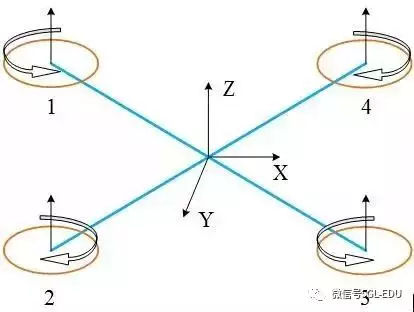
The fuselage of the quadcopter drone is composed of a symmetrical cross-shaped rigid body structure, and the material is mostly made of carbon fiber with light weight and high strength; a rotor consisting of two blades is installed at each of the four ends of the cross-shaped structure to provide flight power for the aircraft. Each rotor is installed on a motor rotor, and the rotation speed of each rotor is controlled by controlling the rotation state of the motor to provide different lift to achieve various postures; each motor is connected to the motor drive component and the central control unit, and the speed is adjusted by the control signal provided by the central control unit; the IMU inertial measurement unit provides the central control unit with attitude solution data, and the detection module on the fuselage provides the drone with the most direct data to understand its own posture, which provides a guarantee for the quadcopter drone to finally achieve autonomous flight in complex environments.
The rotors on the same diagonal line of the quadcopter fuselage are now grouped together. The front and rear rotors rotate in a clockwise direction, thereby generating a clockwise torque; while the left and right rotors rotate in a counterclockwise direction, thereby generating a counterclockwise torque, so that the torques generated by the rotation of the four rotors can offset each other. It can be seen that all the attitude and position control of the quadcopter is achieved by adjusting the speed of the four drive motors. Generally speaking, the motion state of a quadcopter is mainly divided into five states: hovering, vertical motion, rolling motion, pitch motion and yaw motion.
Hovering
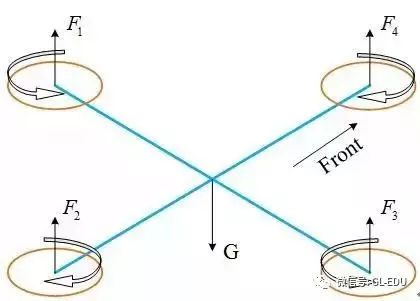
Hovering is a significant feature of quadcopters. In the hovering state, the four rotors have the same rotation speed, and the resulting lifting force is exactly equal to their own gravity, that is. And because the rotor speeds are equal, the rotation speeds of the front and rear ends are opposite to the rotation speeds of the left and right ends, so that the total torque of the aircraft is zero, making the aircraft stationary in the air and achieving a hovering state.
Vertical motion
Vertical motion is the simplest of the five motion states. Under the condition that the rotation speed of each quadcopter is equal, the vertical motion of the aircraft can be achieved by increasing or decreasing the rotation speed of each rotor by the same amount. When the rotation speed of the four rotors is increased at the same time, the total lift generated by the rotors exceeds the gravity of the quadcopter, that is, the quadcopter will rise vertically; conversely, when the rotor speed is reduced at the same time, the total lift generated by each rotor is less than its own gravity, that is, the quadcopter will descend vertically, thereby realizing the vertical lift control of the quadcopter.
Rolling motion
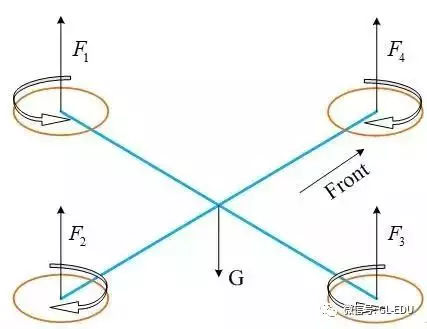
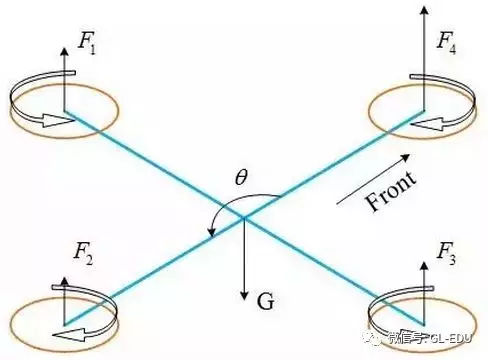
Tumbling motion is to keep the front and rear rotor speeds of the quadcopter unchanged, and change the rotor speeds of the left and right ends to form a certain lift difference between the left and right rotors, so that a certain torque is generated along the left and right symmetric axes of the aircraft body, resulting in angular acceleration in the direction to achieve control. As shown in Figure 2.3, increasing the speed of rotor 1 and reducing the speed of rotor 3 will cause the aircraft to tilt to the right; on the contrary, reducing rotor 4 and increasing rotor 2 will cause the aircraft to tilt to the left.
Pitch motion
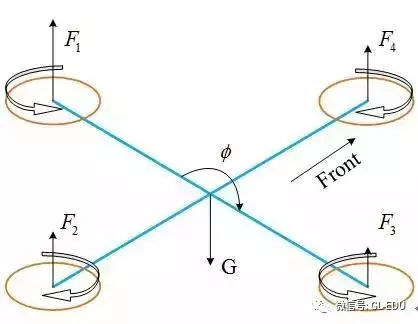
The pitch motion of a quadcopter is similar to rolling motion. It is controlled by changing the front and rear rotor speeds to form a lift difference between the front and rear rotors while keeping the rotor speeds at the left and right ends of the fuselage unchanged, thereby forming a certain torque on the front and rear symmetry axes of the fuselage, causing angular acceleration in the angular direction. As shown in Figure 2.4, if the speed of rotor 3 is increased and the speed of rotor 1 is reduced, the aircraft will tilt forward; otherwise, the aircraft will tilt backward.
Yaw motion
The yaw motion of the quadrotor is controlled by controlling the rotation speed of the four rotors in pairs at the same time. When the rotation speed of the front and rear ends or the left and right ends is kept the same, there will be no pitch or roll motion; and when the two rotors in each group have different rotation speeds from the other group, due to the different rotation directions of the two groups of rotors, it will lead to an imbalance of the anti-torque force, and at this time, a reaction force will be generated around the central axis of the fuselage, causing angular acceleration. As shown in Figure 2.3, when the rotation speed of the front and rear end rotors is equal and greater than the rotation speed of the left and right end rotors, because the former rotates in the clockwise direction and the latter rotates in the opposite direction, the total anti-torque is in the counterclockwise direction, and the reaction force acts on the central axis of the fuselage in the counterclockwise direction, causing counterclockwise yaw motion; otherwise, it will cause clockwise yaw motion of the aircraft.
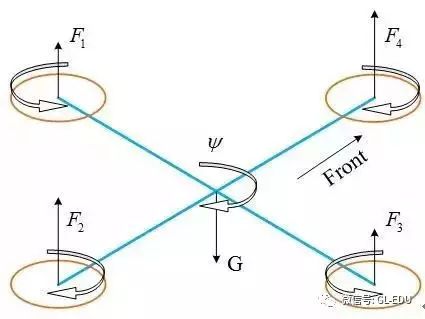
In summary, the control of each flight state of the quadcopter is achieved by controlling the rotation speed of the four symmetrical rotors to form corresponding different motion combinations. However, there are six degrees of freedom output during the flight, so it is a typical under-actuated, strongly coupled nonlinear system. For example, the rotation speed of rotor 1 will cause the drone to roll to the left, and the counterclockwise torque will be greater than the clockwise torque, which will further cause the drone to yaw to the left. In addition, rolling will cause the drone to translate to the left. It can be seen that the attitude and translation of the quadcopter are coupled.